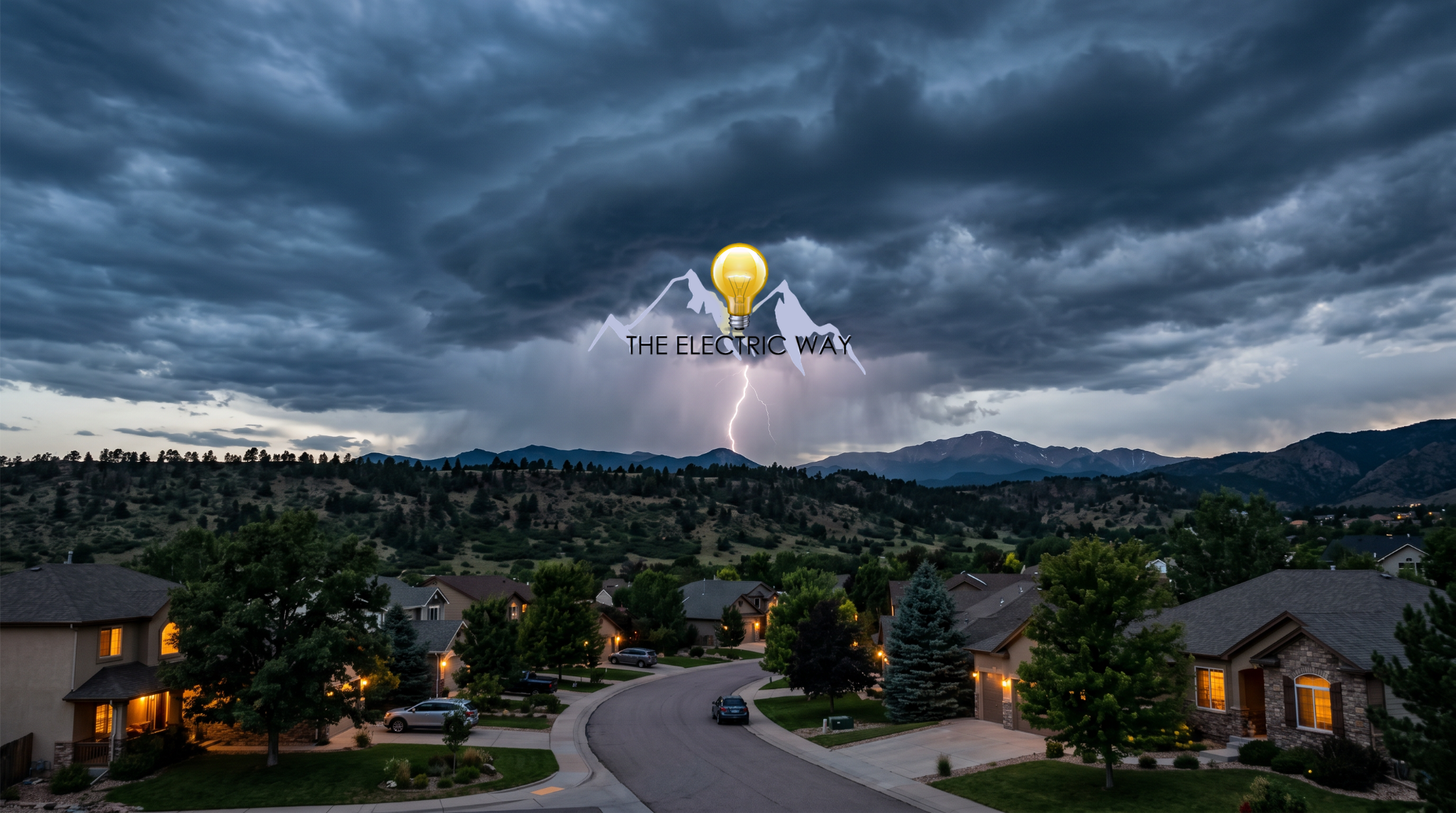
Most people only think about power surges when a storm rolls in and lightning strikes uncomfortably close to home. One Electric Way customer in Colorado Springs had a lightning strike blow a hole in their roof and take out several GFCI outlets along with the electronics connected to them. Luckily, the solution was a simple replacement of the GFCIs, but the electronics were damaged beyond repair.
While those types of power surges are rare, the surges that quietly age your electronics are smaller and far more common. They come off the utility grid and out of your own appliances, all year long. A surge protector wired into the panel is a simple solution that catches them before they reach your devices. This install is so valuable that, as of 2023, electrical code requires it the moment you upgrade your panel.
Surges Are Not Just Lightning
Storms are the obvious culprit, but they are not the only ones (and not even the most common).
- The utility grid. The power feeding your house is never perfectly steady. Switching and other events on the utility side can push a spike of voltage down the line and into your home.
- Your own appliances. Motors that cycle on and off, such as an HVAC system or a well pump, can throw a surge back into your wiring every time they start up.
- Lightning. A strike does not have to hit your house to hurt it. A close one can ride in on the utility lines and reach your panel.
Usually, no single surge is big enough to notice. Stack them up over the years, though, and they wear your electronics down from the inside. Heading off that slow, invisible damage is part of the everyday electrical work and wiring for homeowners in Colorado Springs we handle.
A Power Strip is Not Enough
Homeowners ask us all the time whether a power strip has them covered. It depends on what they are actually trying to fix.
- Need more outlets? Opt for a permanent solution, not a hazardous one. Adding outlets where you need them is a simple job that eliminates the need for unsightly extension cords and crowded power strips.
- Breakers tripping? That is a power problem, not a surge problem. The answer is a dedicated circuit, so a heavy load like a dryer, an EV charger, or a treadmill gets its own line.
- Want to protect your gear? Put the protection at the panel. A strip only guards what is plugged into that one strip. A unit at the panel covers the whole house, including the hardwired equipment a strip never touches.
Outlets, dedicated circuits, surge devices: those are all routine electrical repairs and installation services for us.
What the Install Actually Looks Like
There are two ways we usually go about it, and your panel decides which.
- Inside the panel. If there is room, a plug-in unit drops right in. Under an hour, start to finish.
- Beside the panel. A separate unit mounted next to or just below the panel runs one to two hours and gives you a stronger layer of protection.
Either one meets code, which accepts a Type 1 or Type 2 device. We look at your panel, ask what you are trying to protect, and steer you to the option that fits.
The 2023 Code Changed the Rules on Panel Upgrades
The Pikes Peak Regional Building Department enforces the 2023 National Electrical Code. Under it, a surge protective device is required on a home’s electrical service, and that requirement kicks in any time the service equipment is replaced. Put simply: upgrade your panel, and surge protection comes with it. You can see that scope on our electrical panel upgrade page, and our walkthrough of a breaker box upgrade covers the permits, the utility shutoff, and the timeline.
Not only is this a real benefit, but it is also the law. Every panel upgrade bid should already include it. If a company hands it to you as a “favor”, or tacks it on as a surprise charge, be skeptical. It is code, not a perk to mark up.
Skip the Bargain-Bin Hardware
A surge device is not the place to cut corners. We install name brands we trust, Square D, Leviton, and Eaton. The few dollars an off-brand unit might save you are not worth much the day a real surge comes through.
Why a Licensed Electrician Should Handle This
The device wires straight into your panel, and everything downstream depends on it being done right. A licensed electrician in Colorado Springs makes sure it is sized correctly, connected safely, and, when it ties into a panel or service upgrade, permitted and inspected.
That is how we operate. Clear answers, honest quotes built around your actual home, and no push to buy what you do not need.
Planning a Panel Upgrade or Just Want Peace of Mind?
Maybe an upgrade is already on your list. Maybe you just want your electronics to outlast the next storm. Either way, a surge protector at the panel is a small price for the coverage it buys.
The licensed electricians at The Electric Way install whole-home surge protection for homeowners across Colorado Springs and the surrounding area. Contact us for a free estimate, or call (719) 231-7249 and we will walk you through the options.
Frequently Asked Questions
Will a whole-home surge protector stop lightning damage?
It handles surges that travel through your electrical system, including the ones a nearby strike sends down the utility lines. Nothing can stop a direct lightning strike to your house, but for the everyday surges that quietly wear your electronics down, nothing protects better.
Do I still need one if I use power strips?
Yes. A power strip only covers what is plugged into it. A unit at the panel protects the whole house, including the hardwired things a strip can never reach, like your HVAC system and major appliances.
Is surge protection required by code in Colorado Springs?
Yes. The Pikes Peak Regional Building Department enforces the 2023 National Electrical Code, which requires a surge protective device on a home’s electrical service and any time the service equipment is replaced. A panel or service upgrade includes it.
How long does the install take?
A plug-in unit inside the panel is usually under an hour when there is room. A separate unit mounted beside or below the panel takes about one to two hours.
